
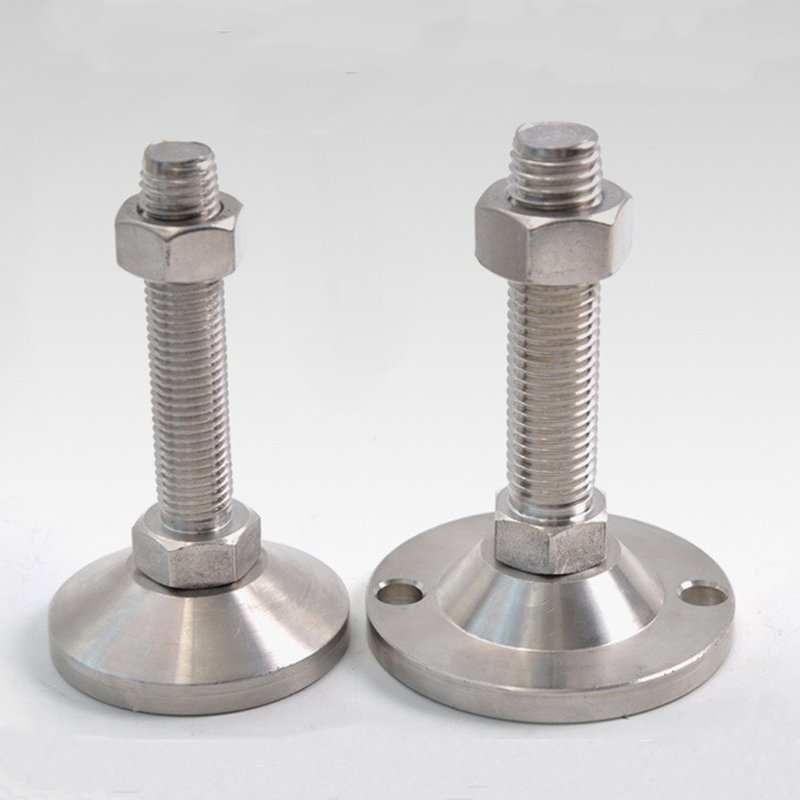
Stainless Steel Leveling Feet for Food Processing Equipment: What to Look For
Choosing the right leveling feet for food processing equipment involves more than getting the dimensions right. Equipment in food production facilities may be exposed to frequent washdowns, moisture, food residues and cleaning chemicals. The support components underneath the machine need to suit those conditions, too.
Stainless steel leveling feet are widely used on food processing machinery, conveyor systems, packaging equipment and stainless steel workstations. They provide adjustable support and offer corrosion resistance, making them a practical option for many production environments.
However, not every stainless steel leveling foot is designed for the same application. Material grade, surface finish, load capacity and mounting style all matter when selecting the right product.
Here’s what to consider before choosing leveling feet for your equipment.
Why Use Stainless Steel Leveling Feet in Food Processing?
Moisture and frequent cleaning can be tough on machine components, particularly those installed close to the floor.
Stainless steel offers better corrosion resistance than ordinary carbon steel in many operating environments. It is also widely used in food processing equipment because it can be cleaned effectively when the surface finish and component design are appropriate.
For equipment manufacturers and plant maintenance teams, stainless steel leveling feet can offer several practical advantages:
Corrosion resistance: Helps withstand moisture and many routine cleaning conditions when the correct grade is selected.
Adjustable support: Makes it easier to level machinery during installation.
Durability: Provides reliable mechanical support when the product is correctly sized and used within its rated load.
Maintenance considerations: A suitable design can make the area around the machine easier to inspect and clean.
Material compatibility: Stainless steel grades can be selected to suit different operating environments.
One point worth keeping in mind: stainless steel is not completely rustproof under every condition. Chlorides, aggressive cleaning chemicals and unsuitable maintenance practices can still cause corrosion.
The right material and design should always be selected for the actual application.
304 vs. 316 Stainless Steel Leveling Feet
One of the first questions to address is whether 304 or 316 stainless steel is the better choice.
Both grades are common in industrial equipment, but their corrosion resistance differs.
304 Stainless Steel
304 stainless steel is a common choice for general-purpose industrial components. It offers good corrosion resistance in many environments and is suitable for a wide range of food processing equipment applications.
It may be appropriate for machine frames, packaging equipment and production workstations exposed to routine moisture and cleaning.
316 Stainless Steel
316 stainless steel contains molybdenum, which generally improves its resistance to chloride-related corrosion compared with 304.
It may be the better option where equipment is exposed to salt, chloride-containing cleaning solutions or more demanding washdown conditions.
The actual performance depends on the chemicals involved, their concentration, temperature and exposure time.
Which grade should you choose?
| Application condition | What to consider |
|---|---|
| General indoor production | 304 stainless steel may be sufficient |
| Frequent washdowns | Evaluate the cleaning chemicals and exposure conditions |
| Salt or chloride exposure | Consider 316 stainless steel |
| Aggressive cleaning processes | Confirm material compatibility with the equipment or chemical supplier |
These are starting points, not universal rules. Check the manufacturer’s recommendations before finalizing the material grade.
Cleanability Depends on More Than the Material
Using stainless steel does not automatically make a component suitable for hygienic applications.
The shape, finish and construction of the leveling foot also affect how easily the surrounding area can be cleaned.
When evaluating leveling feet for food processing equipment, pay attention to the following details.
Surface finish
Smooth, appropriately finished surfaces are generally easier to clean than rough surfaces or areas with unnecessary crevices.
Gaps and recesses
Designs that minimize hard-to-reach pockets can help reduce places where moisture and food residues may accumulate.
Rubber pads and other nonmetallic parts
If the leveling foot includes a rubber pad or other polymer component, check its compatibility with the cleaning chemicals, temperatures and operating conditions.
Access beneath the equipment
The installed machine should allow the required cleaning and inspection procedures to be carried out around its support points.
For applications with strict hygienic design requirements, standard industrial leveling feet may not be sufficient. A purpose-designed hygienic foot may be needed.
Also, do not assume that a stainless steel product is automatically food-grade, NSF-certified or compliant with a particular hygienic design standard. Confirm any required certification or compliance documentation for the specific product.
Load Capacity: Choose Feet That Can Handle the Actual Load
Leveling feet must support the machine reliably throughout normal operation.
Selecting a model based only on the machine’s total weight can lead to an incorrect choice. The load may not be distributed evenly across all support points, especially when the center of gravity is offset or the floor is uneven.
Before choosing a load rating, consider:
The total weight of the machine, including its normal operating load.
The number and position of the support points.
The location of the center of gravity.
Dynamic forces generated during operation.
The mounting arrangement and actual installation conditions.
Do not assume that each foot carries exactly the machine’s total weight divided by the number of feet.
Instead, use the manufacturer’s rated load data and account for the actual load distribution and relevant safety requirements.
For mixers, conveyors, filling systems and other equipment with moving parts, it is also important to distinguish between static load capacity and performance under dynamic operating conditions.
If the load is uncertain, provide the equipment weight and support layout to the manufacturer for review.
Thread Size, Stem Length and Mounting Options
Even a well-made leveling foot can be unsuitable if its dimensions do not match the machine.
When selecting a model, confirm the following specifications.
Thread size and pitch: The threaded stem must match the equipment’s mounting hole or receiving thread.
Stem length: The available length needs to provide sufficient adjustment without requiring excessive extension.
Base diameter: The base must suit the required support arrangement and installation space.
Mounting holes: If the design includes holes for bolts or other fasteners, check their diameter, spacing and compatibility with the mounting surface.
Locking nut: Where provided, a locking nut can help secure the selected adjustment.
Articulation: If the floor is sloped or uneven, an articulating foot may be worth considering, provided the design meets the machine’s load and stability requirements.
For equipment that needs to be anchored against movement, consider whether a bolt-down design is appropriate. The final choice should account for the machine’s operating forces and the floor’s construction.
Standard Leveling Feet or Hygienic Leveling Feet?
This distinction matters when purchasing components for food production equipment.
Standard stainless steel leveling feet are designed primarily to provide adjustable support. They may be suitable for many general industrial applications, including equipment used in food production facilities.
Hygienic leveling feet are designed with additional attention to cleanability and the reduction of areas where residues can collect. Depending on the product, this may involve smoother surfaces, rounded transitions, self-draining features or specialized sealing arrangements.
Not every application requires a hygienic design, but some facilities have specific requirements that standard feet cannot meet.
Before ordering, check whether the equipment specification calls for a particular hygienic design standard, certification or material declaration.
The important point is to match the product to the actual cleaning and compliance requirements, rather than relying on the stainless steel designation alone.
What Information Should You Provide When Requesting a Quote?
If you are sourcing leveling feet for a new machine or replacing existing components, having the specifications ready can make the quotation process more straightforward.
A supplier will typically need some or all of the following information:
Required quantity: The number of leveling feet needed for the equipment or production line.
Thread specification: Thread diameter, pitch and required thread length.
Base dimensions: Base diameter, thickness and any mounting hole details.
Material grade: 304 or 316 stainless steel, or another specified material.
Load requirement: The expected load per foot or the equipment weight and support arrangement.
Operating environment: Cleaning frequency, chemical exposure, moisture and temperature conditions.
Special requirements: Custom dimensions, surface finish, hygienic design or documentation.
A technical drawing or sample of the existing part can also help clarify dimensional requirements.
For OEMs and equipment manufacturers, confirming these details early can reduce the risk of ordering incompatible components and help keep machine assembly on schedule.
FAQ
Are stainless steel leveling feet suitable for washdown environments?
They can be, provided the stainless steel grade, surface finish and overall construction are suitable for the cleaning conditions. The cleaning chemicals, temperature and exposure frequency should all be considered.
Is 304 stainless steel enough for food processing equipment?
304 may be suitable for many general-purpose applications. Where chloride exposure or more aggressive cleaning conditions are involved, 316 may be worth considering. The decision should be based on the actual operating environment.
Can standard stainless steel leveling feet be used in food production facilities?
Yes, in some applications. However, equipment with strict hygienic design requirements may need specially designed leveling feet. Always check the facility’s specifications and applicable requirements.
How do I determine the correct load capacity?
Consider the machine’s weight, center of gravity, support layout and dynamic forces. Use the manufacturer’s load rating and avoid assuming that the load is shared equally across every foot.
Can leveling feet be customized for food processing machinery?
Depending on the manufacturer, custom options may include thread sizes, stem lengths, base dimensions, mounting holes and material grades. Provide a drawing or detailed specification to confirm feasibility.
Find the Right Leveling Feet for Your Equipment
Choosing the right leveling feet comes down to matching the product to the machine, the operating environment and the required installation conditions.
Stainless steel leveling feet can be a reliable choice for many food processing applications, but material grade, load capacity, mounting design and cleanability should all be considered before ordering.
If you are sourcing leveling feet for food processing machinery, conveyor systems or packaging equipment, contact our team with your required dimensions, material grade and load specifications.
We can help you review the requirements and identify a suitable standard product or discuss a custom solution for your application.