Choosing the right precision gears manufacturer is crucial for industrial applications. Precision gears impact the performance, efficiency, and lifespan of machines. Selecting a reliable manufacturer ensures consistent quality, reduces downtime, and improves operational efficiency. Experienced manufacturers provide expertise in material selection, machining accuracy, and quality control. Many industries face equipment failures caused by poorly manufactured gears, leading to costly repairs. Partnering with an experienced manufacturer mitigates these risks and delivers measurable benefits. First-rate gear production requires strict adherence to tolerances and industry standards. Suppliers with proven track records often offer advanced engineering support to optimize gear designs.
Precision Gears Manufacturer and Product Quality Standards
High-quality gears require adherence to precise manufacturing standards. A precision gears manufacturer uses rigorous inspection methods to maintain consistency. Gear dimensions, surface finish, and hardness must meet tight tolerances. Regular calibration of measuring equipment ensures accurate results. Experience helps anticipate potential defects and implement corrective measures. Surface treatment, such as carburizing or nitriding, enhances wear resistance. Many manufacturers follow ISO 9001 or equivalent standards to document quality control procedures. Accurate documentation ensures traceability, making it easier to track production history. Advanced testing includes runout, backlash, and tooth profile verification. Overall, strong quality standards ensure gears perform reliably in demanding applications.
Materials Selection and Heat Treatment Processes
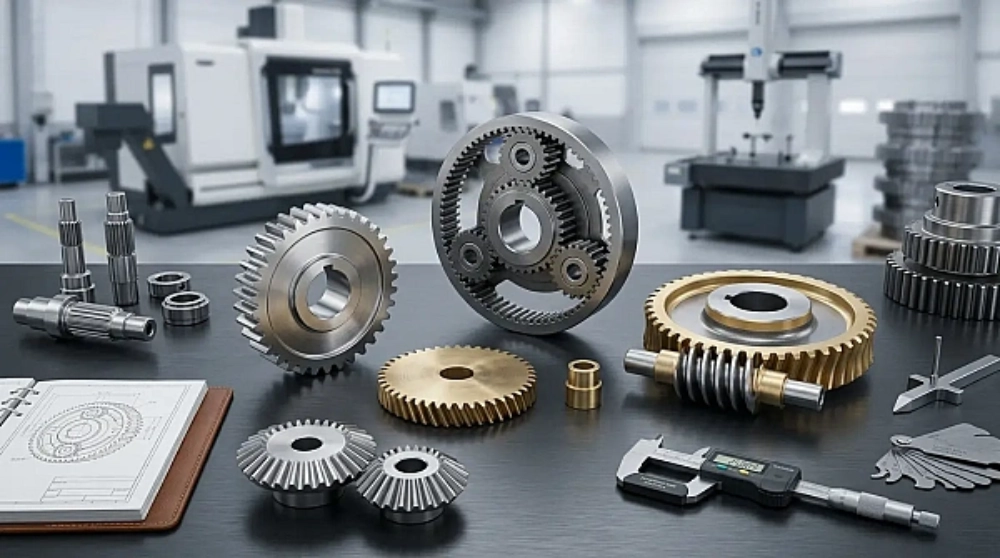
Materials and heat treatment strongly influence gear durability. Alloy steels are commonly used for high-load applications. Heat treatment processes, including quenching, tempering, and induction hardening, optimize hardness and toughness. Proper material selection prevents premature wear and fatigue failures. Manufacturers consider operating conditions, such as torque, speed, and environmental factors, before recommending materials. Spur gear helical gear combinations often require distinct metallurgical treatments to ensure smooth meshing and reduced noise. Surface coatings, like phosphate or DLC films, can improve lubrication and corrosion resistance. Material expertise directly affects long-term gear performance. Choosing an experienced manufacturer guarantees knowledge of proper treatments for various gear types.
Advanced Machining and Production Technologies
Modern precision gear production leverages CNC machinery, hobbing, shaping, and grinding. Automation improves repeatability and reduces human error. Experienced manufacturers optimize process sequences for efficiency and accuracy. Tool wear monitoring prevents dimensional deviations. Precision bevel gear worm gear pairs often demand specialized machining setups. Multi-axis CNC machines allow complex profiles while maintaining tight tolerances. Integration of in-line inspection ensures defects are identified early. Advanced software enables precise gear geometry modeling. The combination of skilled operators and advanced technology ensures gears meet performance requirements consistently. Investing in technology allows manufacturers to handle both prototype and large-scale production efficiently.
Key Certifications and Industry Compliance
ISO 9001 certification sets the global benchmark for quality management systems. Many manufacturers also comply with AGMA standards for gear accuracy and load capacity, DIN 3960 for tooth geometry, and JIS B 1702 for gear inspection methods. Documentation ensures every gear batch can be traced from material sourcing to final inspection. Compliance guarantees gears meet safety, durability, and performance expectations. Regulatory audits often review these certifications in detail. Choosing a manufacturer with recognized standards mitigates risks of non-conformance. Environmental and occupational safety standards, including ISO 14001 and OHSAS 18001, are often integrated into production processes. Certifications reflect both technical capability and process discipline. Clients benefit from reduced liability and assured gear performance. A well-documented manufacturing process simplifies audits and improves overall quality confidence.
Production Capabilities and Capacity of a Precision Gears Manufacturer
Manufacturing experience influences the ability to meet both small and high-volume orders. Experienced manufacturers offer prototype support, custom designs, and scalable production. In-house tooling, inspection labs, and assembly areas enhance control. Lead times are predictable, reducing operational uncertainty. Large-scale production relies on optimized workflow and process standardization. Custom solutions accommodate unique gear ratios, modules, and face widths. Production capacity must align with client requirements to avoid bottlenecks. Reliable delivery schedules contribute to uninterrupted operations. Suppliers with extensive capabilities handle diverse projects efficiently. Effective resource planning and quality management prevent delays and maintain consistency.
Evaluation Criteria for Gear Suppliers
Selecting the right supplier requires careful assessment. Factors include manufacturing experience, quality systems, delivery performance, and engineering support. Price alone is insufficient to determine suitability. Proven technical expertise often outweighs initial cost advantages. Supplier transparency regarding processes, tolerances, and equipment adds confidence. Table comparisons help clarify strengths and weaknesses. Companies can compare capabilities side by side to make informed decisions. Evaluating multiple criteria reduces risk and supports long-term partnerships. Experienced suppliers anticipate challenges and provide solutions proactively. Documentation of past projects often demonstrates reliability. Strong supplier relationships benefit ongoing maintenance and future projects.
Supplier Evaluation Criteria
| Evaluation Factor | Importance | Impact on Operations |
|---|---|---|
| Experience | Provides process stability and reliability | Reduces defect rates and rework |
| Quality Assurance | Ensures tolerance adherence | Improves operational uptime |
| Engineering Support | Optimizes gear designs for performance | Enhances product efficiency |
| Delivery Reliability | Maintains project schedules | Supports uninterrupted production |
Why Total Value Outweighs Cost Alone
Cost should be considered alongside performance, longevity, and maintenance. Low-cost suppliers may compromise tolerances, material quality, or inspection. Operational failures increase long-term expenses. Evaluating total ownership cost encourages smarter procurement decisions. Experienced manufacturers justify higher prices with consistent output, lower failure rates, and fewer warranty claims. Maintenance intervals are extended with higher-quality gears. Reliability affects both safety and productivity. A holistic evaluation framework balances cost with operational benefits. Selecting the right manufacturer reduces unplanned downtime and maintenance expenses. Long-term planning requires considering the complete value of supplied gears.
Services Offered by Leading Manufacturers
Top manufacturers provide consultation, reverse engineering, material guidance, and testing. Technical support improves design efficiency. Collaboration allows optimization of gear ratios and surface treatments. Prototyping ensures design feasibility before mass production. Testing can include torque measurement, load analysis, and acoustic noise assessment. Material recommendations consider strength, hardness, and wear resistance. Leading manufacturers maintain labs for dimensional and metallurgical verification. Continuous improvement initiatives refine processes over time. Skilled teams provide solutions for both standard and custom gear applications. Such services enhance product reliability and client satisfaction.
List: Questions to Ask Potential Suppliers
- What is the maximum gear precision you achieve?
- Which inspection technologies are used routinely?
- What material options are available for different applications?
- Can you produce custom gear profiles?
- What certifications confirm compliance and quality?
Technical Support Enhances Project Success
Manufacturers that provide early engineering involvement reduce risks. Design issues are identified before production begins. A precision gears manufacturer optimizes gear geometry to improve efficiency and reduce wear. Fast problem resolution minimizes downtime during installation. Engineers provide guidance on material selection, tolerances, and assembly techniques. Support ensures proper lubrication methods are applied. Close collaboration reduces the probability of errors. Technical expertise translates into better performance and reduced maintenance. Manufacturers with dedicated support teams help clients adapt to evolving requirements. Effective support strengthens operational reliability.
Gear Material Properties
| Material | Hardness (HRC) | Wear Resistance | Common Applications |
|---|---|---|---|
| Alloy Steel 8620 | 58-62 | High | High-torque machinery applications |
| Carbon Steel 1045 | 55-60 | Moderate | General-purpose gears |
| Stainless Steel 17-4PH | 50-55 | Corrosion-resistant | Food processing equipment |
| Tool Steel D2 | 60-64 | High | Die applications requiring precision |
Building Long-Term Partnerships
Strong relationships improve supply chain stability. Continuous improvement initiatives drive better production efficiency. Collaborative development enables custom solutions. Long-term partnerships reduce uncertainty and improve delivery timelines. Feedback loops allow iterative design improvements. Consistent quality fosters trust between manufacturers and clients. Reliable suppliers help clients maintain production schedules. Strategic partnerships create mutual benefits, including knowledge sharing and innovation. Manufacturers with proven experience reduce operational risks. Partnership-oriented approaches support sustainable growth for both parties.
FAQ
How can gear manufacturing experience affect product performance?
Manufacturing experience directly influences gear precision and reliability. Skilled manufacturers identify potential defects before they affect production quality. Experienced teams select suitable materials and apply appropriate heat treatment processes. Accurate machining reduces vibration, noise, and premature wear during operation. Quality control procedures help maintain consistent dimensional accuracy. Manufacturers with extensive experience can optimize production methods for different gear designs. Engineering knowledge also supports better load distribution and longer service life. Reliable production reduces maintenance requirements and unexpected downtime. Consistent performance improves equipment efficiency across various industries. These advantages make manufacturing experience an important factor when evaluating potential suppliers.
What quality control methods are most important in gear production?
Effective quality control combines inspection, testing, and process monitoring. Coordinate measuring machines verify dimensional accuracy and critical tolerances. Gear measuring systems evaluate tooth profiles, pitch accuracy, and runout. Hardness testing confirms proper heat treatment results. Metallurgical analysis verifies material properties and structural integrity. Statistical process control helps identify trends before defects occur. In-process inspections reduce the likelihood of nonconforming products reaching final assembly. Traceability systems document every production stage and inspection result. Functional testing can evaluate load capacity and operational performance. Together, these methods ensure gears meet strict quality and reliability requirements.
Which factors should buyers prioritize when selecting a supplier?
Buyers should evaluate technical capability, quality assurance systems, and manufacturing experience. Production capacity should match current and future demand requirements. Engineering support is important for custom designs and performance optimization. Material expertise helps ensure durability under specific operating conditions. Inspection equipment and testing capabilities demonstrate commitment to quality. Certifications provide evidence of compliance with recognized industry standards. Delivery performance affects production schedules and inventory planning. Communication and responsiveness also influence project success. Total ownership cost should be considered alongside purchase price. A supplier that performs well in these areas can provide long-term value and dependable product quality.