Gear Material Selection Guide for Industrial Applications
Gear material selection affects load capacity, wear resistance, noise, corrosion behavior, manufacturing cost, and service life. A material that performs well in a lightly loaded instrument may fail quickly in a shock-loaded industrial drive. A material selected only for strength may also create avoidable machining, heat-treatment, or lubrication problems.
The correct choice starts with the application. Gear type, torque, speed, duty cycle, environment, accuracy, mating material, lubrication, production quantity, and maintenance expectations all influence the decision.
This guide provides a practical framework for comparing common gear material families and preparing a clear specification for a custom gear project. Precision bevel gear worm gear applications may require particular attention to material stability, dimensional accuracy, surface finish, and compatibility with the mating components.
Start With Operating Conditions
Before selecting a grade, define the conditions the gear must survive:
- Continuous, intermittent, or shock loading
- Torque and transmitted power
- Rotational speed and duty cycle
- Spur, helical, bevel, worm, rack, or internal gear geometry
- Lubricated, dry-running, or limited-lubrication operation
- Temperature range
- Moisture, chemicals, salt, dust, or washdown exposure
- Noise and vibration requirements
- Expected service life and maintenance access
- Production quantity and replacement strategy
These inputs determine which failure risks matter most and whether a simple material is sufficient or a heat-treated alloy is justified.
Comparing Common Gear Material Families
| Material family | Common strengths | Important limitations | Typical selection reason |
|---|---|---|---|
| Carbon steel | Availability, cost, machinability, heat-treatment options | Corrosion protection may be required | General industrial gears with moderate requirements |
| Alloy steel | Strength, hardenability, fatigue and wear potential | Higher material and processing cost | Higher load, shock, fatigue, or demanding duty |
| Stainless steel | Corrosion resistance and clean-environment suitability | Grade and heat treatment strongly affect strength and machinability | Food, marine, chemical, or washdown environments |
| Cast iron / ductile iron | Damping, castability, cost for suitable sizes | Not appropriate for every shock or high-strength requirement | Large or moderate-duty gears where damping and economy matter |
| Bronze | Sliding and anti-galling behavior in suitable pairs | Cost and strength limits require design review | Worm wheels and sliding-contact applications |
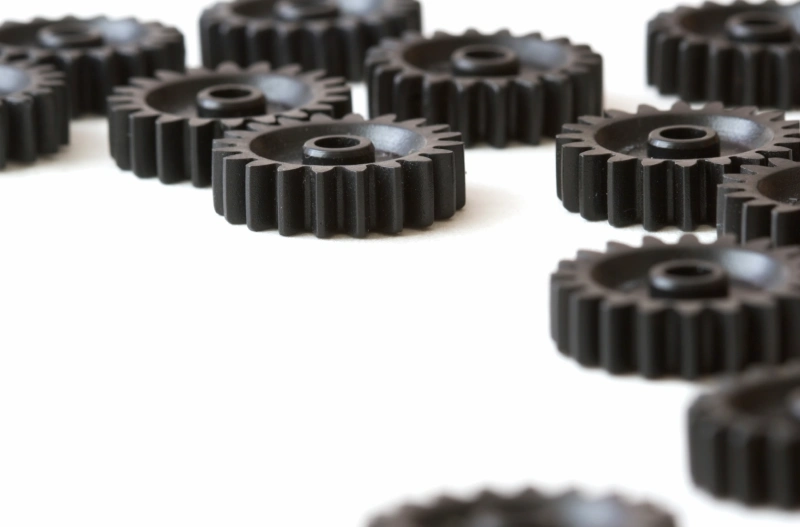
| Engineering plastics | Low noise, low weight, corrosion resistance, possible dry operation | Temperature, moisture, creep, and lower load capacity | Light-duty, quiet, clean, or high-volume mechanisms |
Material-family comparisons help narrow the choice, but the final specification must identify the exact grade, condition, and processing route.
Match the Material to the Failure Mode
Different gears fail for different reasons. Material selection should address the dominant risk rather than relying on one general strength value.
Contact Fatigue and Pitting
Repeated contact stress on the tooth flank can initiate surface or subsurface damage. Surface hardness, material cleanliness, heat treatment, finish, geometry, and lubrication all influence resistance to pitting.
Root Bending Fatigue
The tooth root carries repeated bending stress. The core needs adequate strength and toughness, and the root geometry and surface condition must avoid unnecessary stress concentration. Spur gear helical gear designs may require different considerations because their tooth engagement and load distribution can affect bending stress.
Scuffing and Adhesive Wear
High sliding, insufficient lubricant film, temperature, surface roughness, and incompatible material pairs can cause scuffing or material transfer. Worm gears and other sliding-dominant contacts need special attention to the material pair and lubricant.
Corrosion and Environmental Attack
Water, chemicals, cleaning agents, and marine exposure can make corrosion resistance a primary requirement. A protective finish may be suitable in some cases; in others, the base material must provide the resistance.
Creep and Thermal Softening in Plastics
Plastic gears may be limited by temperature, continuous load, moisture, or long-term deformation rather than by the same fatigue mechanisms that control steel gears. The exact resin grade and operating environment must be evaluated.
How Heat Treatment Changes Gear Performance
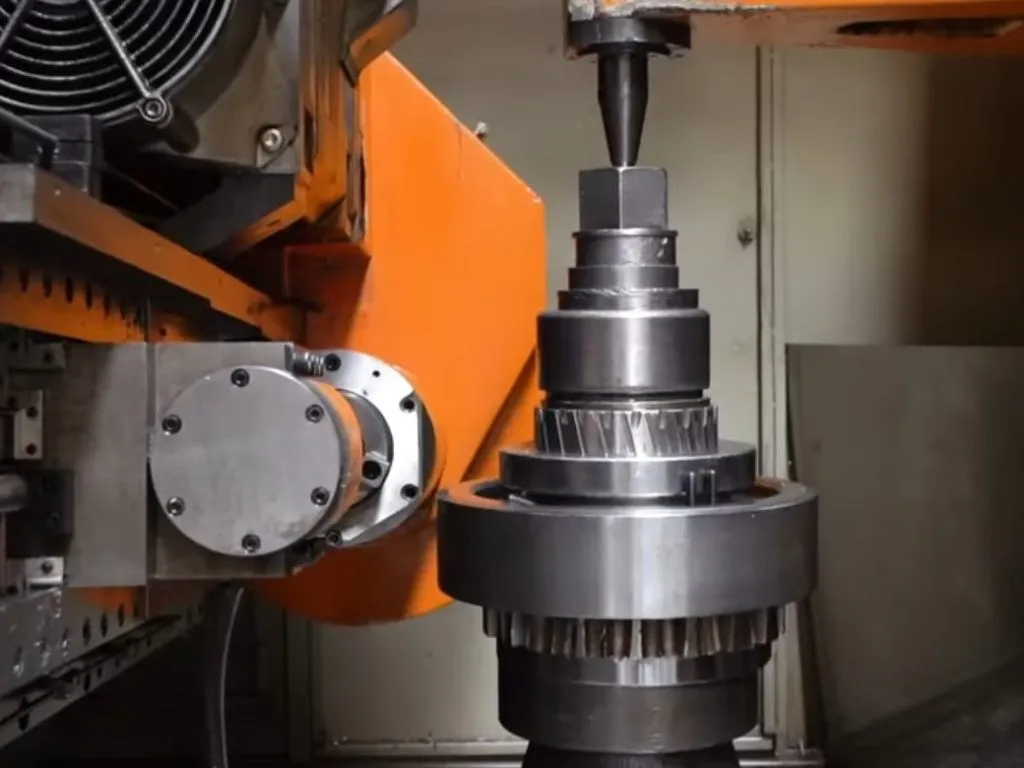
Heat treatment is part of the material specification, not an afterthought.
Through Hardening
Through hardening increases hardness and strength through the section. It can suit gears that need a balance of strength and wear resistance, but the final condition must still provide adequate toughness.
Carburizing and Case Hardening
Case-hardening processes produce a hard wear-resistant surface with a tougher core when the material and process are correctly specified. They are widely considered for gears exposed to high contact stress.
Nitriding
Nitriding creates a hard surface layer at a lower process temperature than many conventional hardening routes. It may help where surface wear and distortion control are important, subject to material and case requirements.
Induction Hardening
Induction hardening can selectively harden tooth surfaces. Process control, geometry, material response, and hardness pattern all require review.
Heat treatment can change dimensions. The manufacturing sequence may need to include stock allowance, stress relief, hard finishing, grinding, and inspection after treatment.
Gear Type Changes the Material Decision
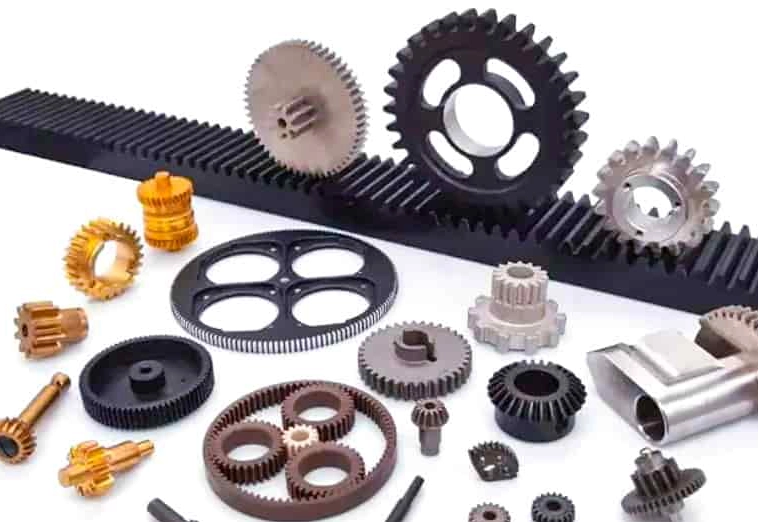
A spur gear, helical gear, bevel gear, and worm pair do not experience identical contact conditions.
- Spur gears are straightforward to manufacture but still require contact and bending checks.
- Helical gears distribute engagement gradually but introduce axial load and sliding.
- Bevel gears transmit motion between intersecting shafts and require careful control of geometry and contact pattern.
- Worm sets have substantial sliding, making material pairing, lubrication, and heat especially important.
- Plastic gears can reduce noise and weight, but load, temperature, moisture, and duty cycle must be derated for the selected grade.
Do not transfer a successful material specification from one gear type to another without checking the actual load and contact conditions.
Balance Performance With Manufacturability
A high-performance material is not automatically the best commercial choice. Consider:
- Raw-material availability and minimum order quantity
- Machinability before heat treatment
- Distortion risk during heat treatment
- Need for grinding or other hard finishing
- Inspection and certification requirements
- Batch size and repeatability
- Lead time for material and outsourced processes
- Total cost of failure, maintenance, and replacement
For prototypes or low-volume parts, an available material with a well-controlled process may be more practical than an exotic grade with a long procurement cycle.
Information to Put on the Drawing or RFQ
A useful gear RFQ should include:
- Gear type and relevant geometry
- Module or diametral pitch
- Tooth count, pressure angle, helix angle, and face width where applicable
- Bore, keyway, spline, hub, and mounting details
- Torque, speed, duty cycle, and shock-load information
- Operating temperature and environment
- Material grade and condition, if already selected
- Required heat treatment and post-treatment finishing
- Accuracy, inspection, and reporting requirements
- Surface finish and coating requirements
- Quantity, annual demand, and prototype needs
- Mating-gear information when material compatibility matters
If the material has not been selected, provide the operating requirements instead of guessing a grade.
Practical Selection Sequence
- Define load, speed, duty cycle, geometry, and environment.
- Identify the likely failure modes.
- Select a material family that addresses those risks.
- Choose the grade and heat-treatment route together.
- Confirm machinability, distortion control, finishing, and inspection.
- Review availability, production quantity, lead time, and total cost.
- Validate the choice through design calculations, applicable standards, and engineering review.
Conclusion
Reliable gear material selection is a system decision. The base material, heat treatment, tooth geometry, surface finish, lubricant, manufacturing sequence, and inspection plan must support the same operating requirements.
Begin with the application, identify the dominant failure risks, and specify the material and process together. This produces a more defensible result than selecting a familiar grade first and trying to make the design fit afterward.
Frequently Asked Questions
What is the best material for an industrial gear
There is no universal best material. The answer depends on load, speed, gear type, environment, lubrication, noise, production volume, and expected life.
When should alloy steel be considered
Alloy steel may be considered when strength, hardenability, fatigue resistance, or shock performance exceeds what a simpler material can provide. The grade and heat treatment must be selected together.
Why is bronze often used with worm gears
Worm gearing involves substantial sliding. A suitable bronze wheel paired with a hardened steel worm can provide favorable sliding and anti-galling behavior, but the exact alloy, lubricant, speed, load, and thermal design still require calculation.
Can plastic replace metal in a gear application
Plastic may suit light-duty, low-noise, corrosion-resistant, or high-volume applications. Temperature, moisture, creep, wear, and duty cycle must be checked for the exact resin grade.