Stainless Steel vs. Cast Iron Handwheels: Why Choose 304 Stainless Steel?
When selecting handwheels for industrial machinery, material choice affects more than the initial purchase price. Corrosion resistance, mechanical performance, equipment weight, maintenance requirements, and operating conditions all influence long-term value.Stainless Steel Handwheels will be a great choice.
Stainless steel handwheels and cast iron handwheels are two common options for industrial equipment. Cast iron offers good rigidity, wear resistance, and cost advantages in many traditional machinery applications. However, 304 stainless steel provides better corrosion resistance in a wide range of everyday industrial environments, making it a practical choice for equipment exposed to moisture, regular cleaning, or demanding working conditions.
So, which material should you choose? This guide compares stainless steel and cast iron handwheels and explains why 304 stainless steel is worth considering for modern industrial equipment.
1. Stainless Steel vs. Cast Iron Handwheels: What Is the Difference?
Both materials serve industrial applications, but they offer different performance characteristics.
304 Stainless Steel Handwheels
304 stainless steel is an austenitic stainless steel containing chromium and nickel. It develops a protective passive surface layer that helps resist corrosion in many common environments.
Manufacturers use 304 stainless steel for components that require a combination of corrosion resistance, durability, and a clean metallic finish. It is commonly found in food processing equipment, industrial machinery, architectural hardware, and other applications where moisture resistance matters.
Cast Iron Handwheels
Cast iron is a traditional material for industrial machine components. It offers good compressive strength, rigidity, and wear resistance, making it suitable for many heavy-duty mechanical applications.
Cast iron is also relatively easy to cast into complex shapes and can provide an economical solution for large or high-volume components. However, ordinary cast iron can rust when exposed to moisture without suitable surface protection. Its relatively low ductility also makes it more susceptible to fracture under certain impact or tensile loading conditions.
Material Comparison
| Comparison Factor | 304 Stainless Steel | Cast Iron |
|---|---|---|
| Corrosion Resistance | Good in many common environments | Requires suitable protection in moisture-exposed environments |
| Mechanical Characteristics | Good strength and ductility | Good rigidity and compressive strength |
| Weight | Relatively heavy | Generally heavy; varies by design |
| Impact Behavior | Generally more ductile | More brittle |
| Surface Protection | Often does not require conventional paint protection | Commonly uses paint or protective coatings |
| Maintenance | Lower corrosion-related maintenance in suitable environments | May require coating inspection and maintenance |
| Manufacturing | Machining, welding, forming, and other processes | Well suited to casting |
| Initial Cost | Generally higher | Often more economical |
The best material depends on the operating environment, component geometry, mechanical requirements, and production volume. Neither material is automatically the better choice for every handwheel application.
2. Why Choose 304 Stainless Steel Handwheels?
For equipment manufacturers and industrial buyers, 304 stainless steel offers several practical advantages.
Better Corrosion Resistance
Corrosion can affect the appearance, surface condition, and service life of industrial components.
Unlike ordinary cast iron, 304 stainless steel forms a passive chromium-rich surface layer that helps protect it from corrosion. This makes it suitable for many applications involving moisture, occasional water exposure, and regular cleaning.
For machinery used in food processing, packaging, pharmaceuticals, and other industries with frequent cleaning requirements, stainless steel can help reduce corrosion-related maintenance.
However, 304 stainless steel is not corrosion-proof. Chlorides, bleach, certain cleaning chemicals, and aggressive operating environments can cause pitting or other forms of corrosion. Buyers should evaluate actual exposure conditions before selecting the material.
Reduced Dependence on Protective Coatings
Cast iron handwheels commonly rely on paint or other protective coatings to reduce surface corrosion.
These coatings require appropriate application and maintenance. Scratches, impacts, or coating damage may expose the underlying metal to moisture and accelerate rust formation.
304 stainless steel generally offers good corrosion resistance without relying on conventional paint coatings. This can simplify surface protection requirements in suitable environments.
For equipment manufacturers, this may also reduce concerns about coating damage during assembly, handling, and routine maintenance.
Suitable for Hygienic and Washdown Environments
In food processing and beverage production, equipment components may encounter water, cleaning chemicals, and frequent washdowns.
304 stainless steel is widely used in food-related equipment because of its corrosion resistance and cleanable surface characteristics.
Stainless steel handwheels can support equipment designs that prioritize material consistency and easier maintenance. However, hygienic performance also depends on surface finish, component geometry, weld quality, and installation details.
An all-stainless-steel component does not automatically qualify as hygienic equipment. Manufacturers must evaluate the complete design and applicable sanitation requirements.
Durable for Repeated Industrial Operation
Handwheels are frequently used to adjust machine positions, control mechanical settings, and secure equipment components.
304 stainless steel combines good strength with ductility, making it suitable for many industrial handwheel designs.
The final mechanical performance still depends on the handwheel’s dimensions, hub structure, spoke design, connection method, and operating loads. Buyers should confirm these details rather than selecting a material based on its name alone.
A Professional and Consistent Appearance
Stainless steel provides a clean metallic appearance that suits modern industrial machinery.
Depending on the required finish, manufacturers can supply polished, brushed, or other suitable surface finishes. This flexibility helps equipment manufacturers maintain a consistent appearance across their machine assemblies.
3. When Is Cast Iron Still a Better Choice?
Although stainless steel offers important corrosion-resistance advantages, cast iron remains a practical option for many industrial applications.
Consider cast iron when:
-
Cost is a major consideration: Cast iron can offer a lower initial material and manufacturing cost for suitable designs and production volumes.
-
The environment is relatively dry: Equipment operating indoors under controlled conditions may not require the additional corrosion resistance of stainless steel.
-
High rigidity is important: Certain cast iron grades offer useful stiffness and compressive strength for specific mechanical designs.
-
The design suits casting: Complex shapes and larger components may be more economical to produce through casting.
For buyers sourcing traditional machine tool components or handwheels for dry industrial environments, cast iron may provide a cost-effective solution.
The important point is to match the material to the actual application rather than assuming that stainless steel must always replace cast iron.
4. Which Industrial Applications Benefit from 304 Stainless Steel Handwheels?
304 stainless steel handwheels are particularly useful when equipment requires corrosion resistance, convenient cleaning, and durable metal construction.
Common applications include:
Food Processing Equipment
Food machinery often operates in environments involving moisture, food residues, and routine cleaning. Stainless steel handwheels can support equipment designs that require corrosion-resistant metal components.
Packaging Machinery
Packaging lines may require frequent manual adjustments during product changeovers and equipment maintenance. Stainless steel handwheels provide a durable option for suitable adjustment mechanisms.
Pharmaceutical and Laboratory Equipment
Certain pharmaceutical and laboratory environments require components with suitable corrosion resistance and surface characteristics. Material and design selection should follow the equipment’s specific cleaning and operating requirements.
Industrial Automation
Automated equipment often incorporates manual adjustment points for positioning, calibration, and maintenance. Stainless steel handwheels can serve as durable manual control components within these assemblies.
Marine and Moisture-Exposed Equipment
Equipment exposed to humidity and moisture may benefit from stainless steel components. However, 304 stainless steel has limitations in saltwater and high-chloride environments. Buyers should evaluate 316 stainless steel or other suitable materials for more aggressive marine conditions.
5. How to Choose the Right Stainless Steel Handwheel
Selecting the right handwheel involves more than choosing between stainless steel and cast iron. Equipment manufacturers and procurement teams should evaluate several technical details.
Material Grade: Choose 304 stainless steel for suitable general industrial applications. Consider 316 stainless steel when the environment requires greater resistance to chlorides and certain corrosive chemicals.
Handwheel Diameter: Select a wheel diameter that provides sufficient leverage and comfortable manual operation without interfering with surrounding equipment.
Hub and Bore Design: Confirm the center bore, keyway, threaded connection, or other mounting interface according to the shaft design.
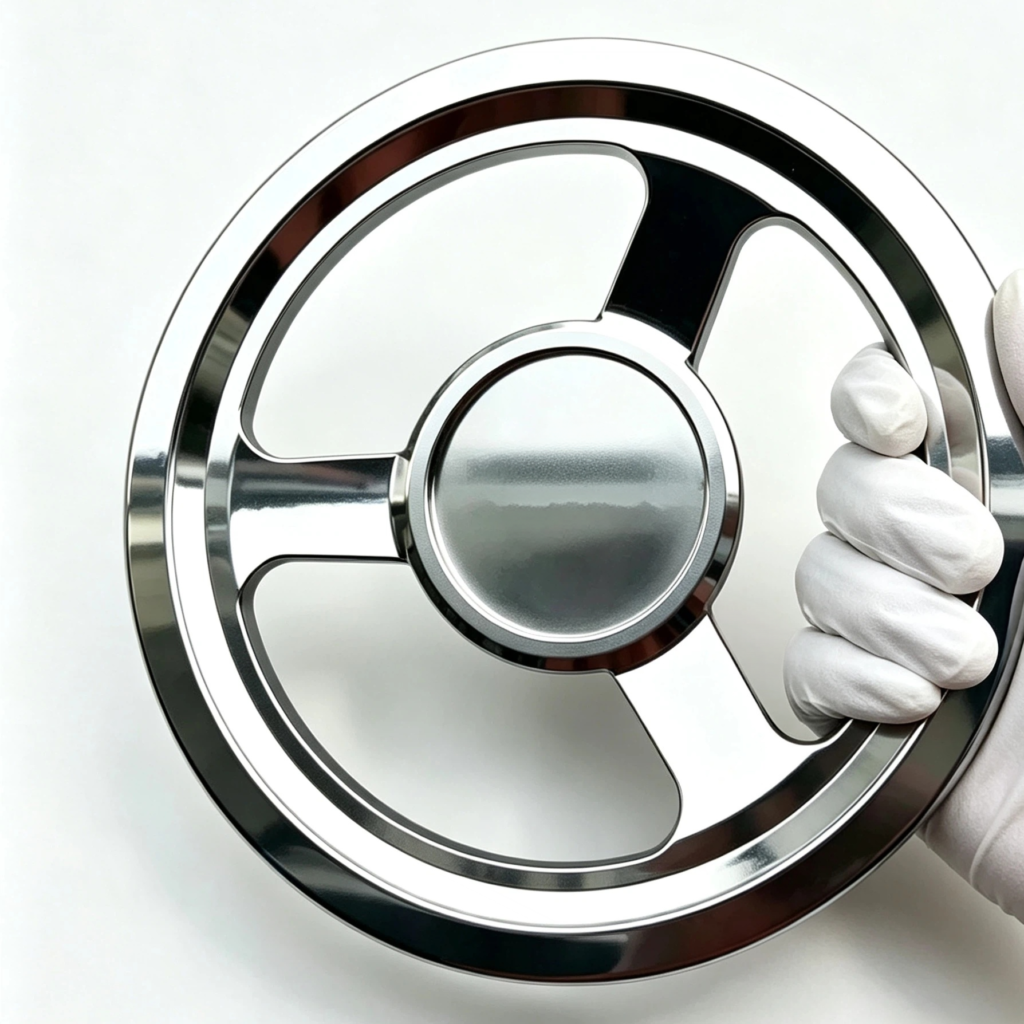
Spoke Structure: Consider the number of spokes, their dimensions, and the connection between the spokes and outer rim.
Surface Finish: Specify polishing, brushing, or another suitable finish according to appearance and operating requirements.
Manufacturing Tolerances: Identify critical dimensions and acceptable tolerances to ensure proper assembly and consistent replacement parts.
Operating Conditions: Consider moisture, cleaning chemicals, temperature, operating loads, and adjustment frequency before confirming the material.
Providing complete specifications helps suppliers assess manufacturing feasibility and prepare more accurate quotations.
6. Why Source Custom Stainless Steel Handwheels from an OEM Manufacturer?
Standard handwheels do not always meet the requirements of specialized industrial equipment. OEM manufacturers may need specific diameters, bore sizes, keyway configurations, spoke structures, or surface finishes.
Working with an experienced custom handwheel manufacturer helps buyers coordinate these requirements before production.
A capable manufacturing partner should offer:
-
Drawing-based design and manufacturing support.
-
Custom 304 and 316 stainless steel material options.
-
CNC machining and precision dimensional control.
-
Welding and assembly capabilities where required.
-
Surface finishing and inspection arrangements.
-
Prototype development and repeat production support.
At Zhejiang Dream Industry Limited, we specialize in custom CNC machined parts and precision metal components, with more than 20 years of manufacturing experience.
Our manufacturing capabilities include stainless steel handwheels, knobs, handles, and other customized mechanical components. We support OEM projects from drawing evaluation and prototype development to production and quality inspection.
Whether you need a standard stainless steel handwheel or a customized design with a specific bore, keyway, or mounting configuration, our team can review your requirements and discuss suitable manufacturing options.
Frequently Asked Questions
Are stainless steel handwheels better than cast iron handwheels?
Stainless steel handwheels generally offer better corrosion resistance and greater ductility, while cast iron handwheels can provide good rigidity and lower initial costs. The right option depends on the operating environment, mechanical requirements, and budget.
Is 304 stainless steel suitable for industrial handwheels?
Yes. 304 stainless steel is suitable for many industrial applications requiring corrosion resistance, durability, and a clean metallic finish. It is commonly used in machinery, food-related equipment, and general industrial components.
Do 304 stainless steel handwheels rust?
304 stainless steel resists corrosion in many common environments, but it is not completely rust-proof. Chloride exposure, aggressive chemicals, surface contamination, and unsuitable cleaning practices can cause corrosion.
Are stainless steel handwheels suitable for food processing equipment?
They can be suitable for food processing equipment because 304 stainless steel offers good corrosion resistance and can support cleanable component designs. However, the surface finish, geometry, installation, and applicable hygiene requirements must also be considered.
Should I choose 304 or 316 stainless steel for a handwheel?
304 stainless steel works well in many general industrial environments. 316 stainless steel offers better resistance to many chloride-containing environments and may be more appropriate for marine or aggressive cleaning conditions.
Can stainless steel handwheels be customized?
Yes. Manufacturers can evaluate custom wheel diameters, hub dimensions, bore sizes, keyways, spoke structures, and surface finishes based on technical drawings, CAD files, or physical samples.
Conclusion
Both stainless steel and cast iron have important roles in industrial handwheel manufacturing. Cast iron remains a cost-effective option for many traditional machinery applications, while 304 stainless steel offers a valuable combination of corrosion resistance, durability, and surface appearance.
For equipment operating in humid environments, food processing facilities, or applications involving regular cleaning, 304 stainless steel handwheels can provide practical long-term advantages.
If you are sourcing stainless steel handwheels for an OEM project, send us your drawings, dimensions, and application requirements. Our team can help evaluate the manufacturing options and provide a quotation for your project.